



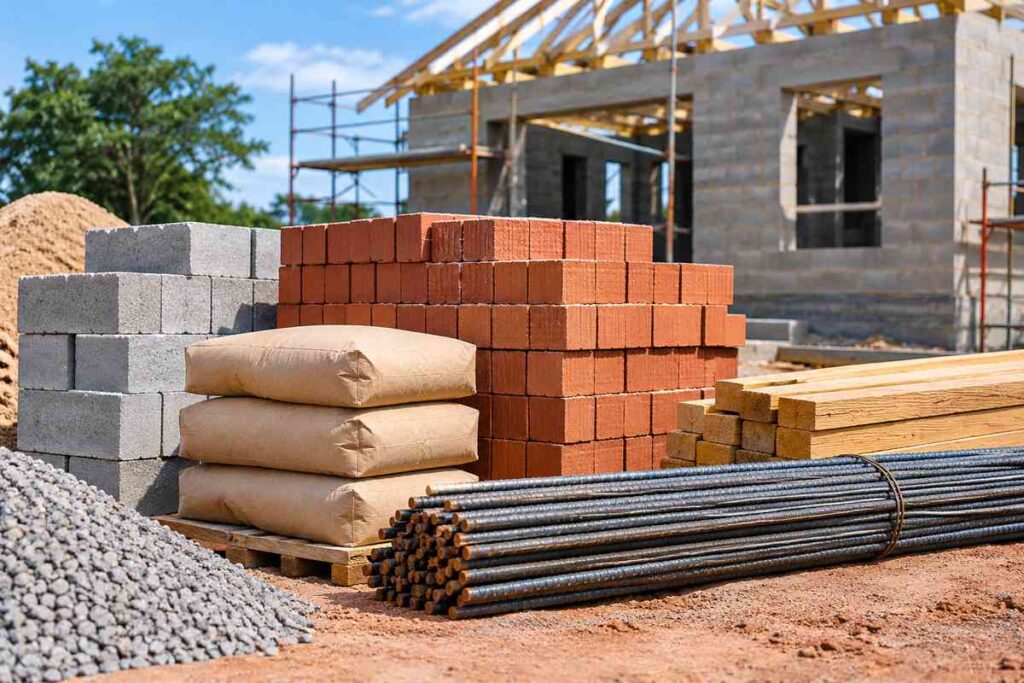
Cement is a powdered binder; concrete is a composite material made by mixing cementitious binder, water, sand and coarse aggregate. Cement reacts with water to form a hardened paste that binds the aggregate. You buy cement to make a mix, but you use concrete to construct elements such as foundations and slabs.
What is cement?
Common cement is manufactured from finely ground clinker and other permitted constituents. When water is added, chemical reactions called hydration develop the binding properties. Different cement products have different strength development and intended applications. In South Africa, cement bags commonly identify a strength class and whether early strength development is normal or rapid. These markings describe the cement, not the final strength of concrete made with it.
What is concrete made from?
Concrete combines a binder with fine aggregate, coarse aggregate and water. Admixtures may be included to modify workability, setting or other properties. The aggregate forms a granular skeleton while the paste fills spaces and binds the particles. Concrete can be delivered ready-mixed or batched on site using controlled proportions.
Concrete strength depends on the mix design, water-to-binder ratio, materials, compaction and curing. Adding water simply to make a stiff mix easier to place can reduce strength and durability. Structural concrete should meet the project specification rather than a universal recipe.
Cement, concrete and mortar compared
| Material | Typical purpose |
|---|---|
| Cement | Binder in concrete, mortar and other cementitious products |
| Concrete | Slabs, beams, foundations and other designed elements |
| Mortar | Bedding masonry units and filling joints |
Mortar usually contains sand, binder and water rather than the coarse stone used in ordinary concrete. Plaster is formulated for application to surfaces. A masonry cement intended for mortar should not automatically be substituted for a cement specified for structural concrete.
Practical example: planning a concrete slab
A rectangular slab measuring 4 m by 3 m and 100 mm thick has a theoretical volume of 1.2 cubic metres. This calculation does not establish whether the thickness or reinforcement is structurally adequate. Confirm the design, actual excavation dimensions and ordering allowance before buying materials. Our concrete calculator and cement calculator can assist with preliminary estimates.
For South African material selection and mix guidance, consult the Concrete Society of Southern Africa technical leaflets and the specified cement supplier.
Frequently asked questions
Cement paste has specialist uses, but it is not a substitute for designed concrete or mortar. Pure paste can shrink considerably and is generally unsuitable for ordinary structural placement.
They are different materials, so a direct strength comparison is misleading. Concrete strength is measured on the hardened composite and depends on its mix and curing.
Concrete hardens mainly through hydration. Curing maintains suitable moisture and temperature so hydration can continue; rapid drying can harm the surface and strength.
Related construction questions
Have More Construction Questions?
Explore our South African construction knowledge hub for practical answers about building materials, costs, regulations, construction methods and more.
Browse All Construction Questions