



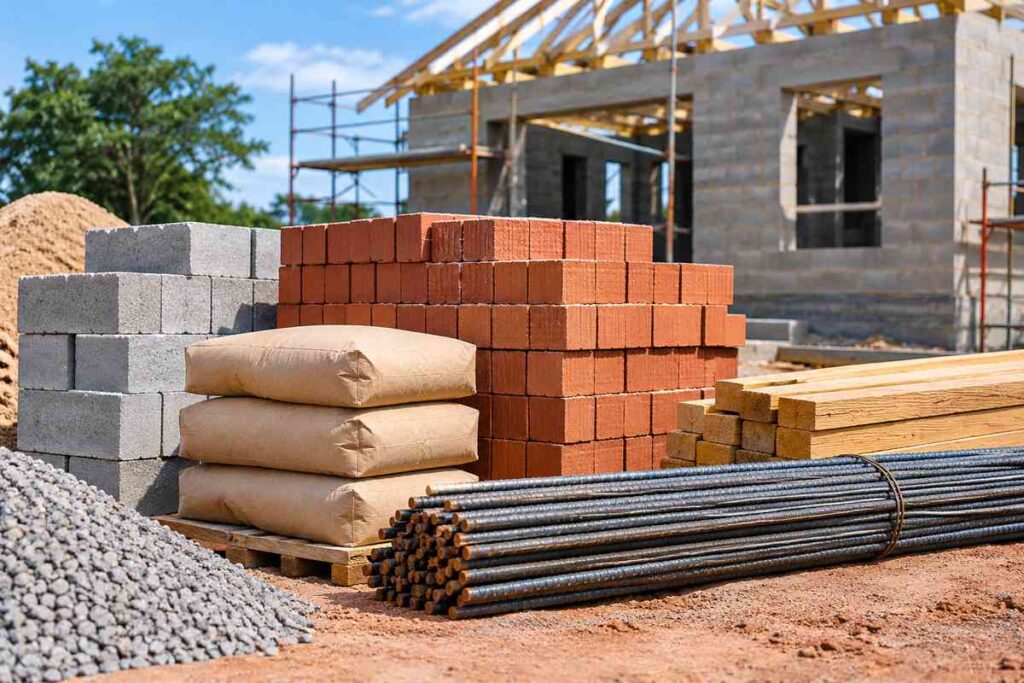
Aggregate is the granular material in concrete, usually sand and crushed stone or gravel. It occupies much of the concrete volume and forms a skeleton held together by hardened cement paste. Its grading, shape, strength and cleanliness influence how fresh concrete behaves and how the finished material performs.
Fine and coarse aggregate
Fine aggregate consists primarily of sand-sized particles. It fills spaces between larger particles and helps create a cohesive mixture. Coarse aggregate consists of larger stone or gravel particles. Together they provide bulk and help limit the amount of cement paste required to produce a workable concrete.
South African suppliers commonly offer crushed stone in nominal sizes such as 13 mm and 19 mm. These labels describe product size categories, not the exact size of every particle. The designer or mix supplier selects a suitable maximum aggregate size for the element and placement method.
Why aggregate grading matters
Grading describes the distribution of particle sizes. A suitable combination can reduce voids and improve packing, allowing a mix to achieve the required workability without excessive paste or water. Poor grading can contribute to segregation, harsh mixes or difficulties in finishing. Angular crushed stone and rounded gravel can behave differently, so a change of source may require adjustments to the mix.
What makes aggregate suitable for concrete?
- Appropriate grading and maximum particle size.
- Suitable strength and resistance to deterioration.
- Acceptable levels of dust, clay, organic matter and other contaminants.
- Compatibility with the cementitious binder and intended exposure.
Some aggregates can react adversely with alkalis in concrete under certain conditions. For important structural work, the supplier and designer should evaluate relevant test data rather than assuming any locally available stone is acceptable.
Practical example: a reinforced slab
When placing concrete around closely spaced reinforcement, aggregate must pass between bars and allow proper compaction. An unsuitable maximum size may contribute to voids or honeycombing. The solution is to specify an appropriate mix and placement method, not to add water indiscriminately. Aggregate moisture also affects the amount of mixing water needed when batching on site.
For material specifications and production guidance, see the AfriSam technical reference guide. Use our concrete calculator for preliminary volume estimates and compare aggregate suppliers before ordering.
Frequently asked questions
Sand and cement can form mortar or specialised fine-grained mixes, but ordinary structural concrete normally includes coarse aggregate. Follow the specified mix.
It can be suitable for specified applications if its properties, contamination levels and mix performance are assessed. It is not an automatic replacement for natural aggregate.
Not necessarily. Strength depends on the complete mix, aggregate properties, water content, compaction and curing.
Related construction questions
- What is the difference between cement and concrete?
- What is the difference between plaster sand and building sand?
- What is ready-mix concrete?
Have More Construction Questions?
Explore our South African construction knowledge hub for practical answers about building materials, costs, regulations, construction methods and more.
Browse All Construction Questions