



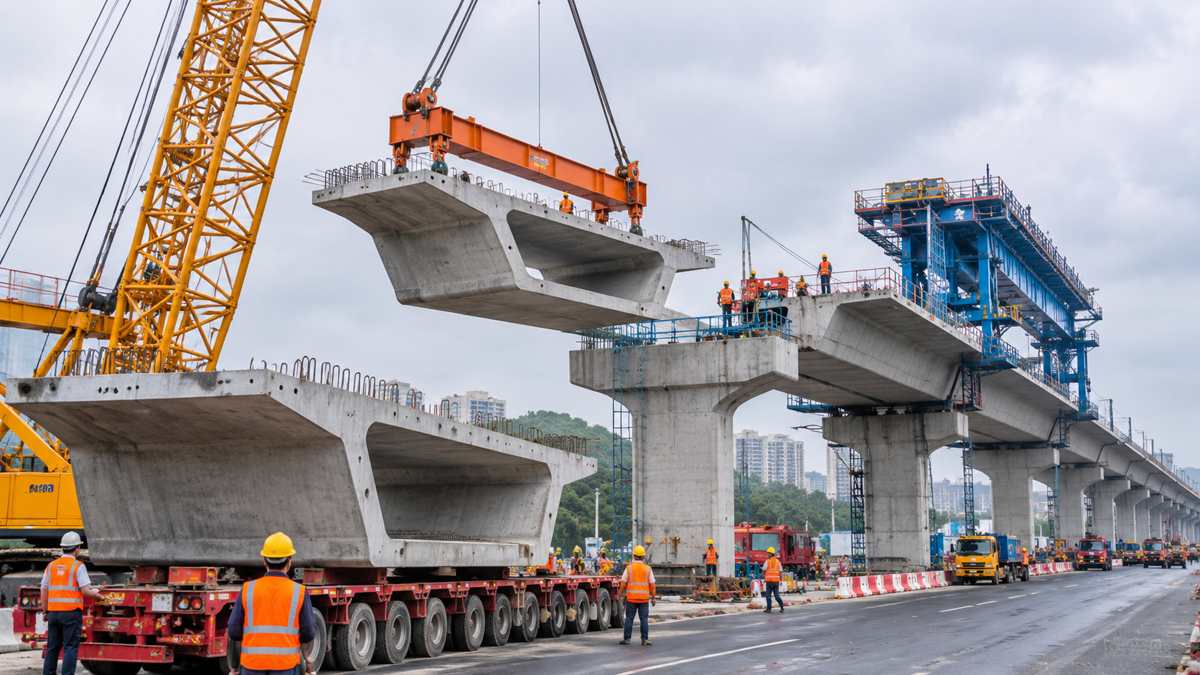
Prefabricated bridge construction in China: precast segments and assembly
Factory production and site assembly
Prefabrication allows bridge components to be manufactured in controlled casting yards while foundations and piers are built on site. In China, this approach is relevant to extensive road and railway infrastructure where repeated spans can justify dedicated production facilities. It is not suitable for every crossing, and transport routes and erection constraints affect the decision.
Coordinating interfaces
Segment geometry, reinforcement, embedments and bearing interfaces need careful dimensional control. Engineers develop erection sequences that account for temporary stability and construction-stage loading. Concrete strength, curing and inspection records must be traceable before units are released for transport.
Logistics and long-term performance
Delivery routes, storage areas and specialist lifting equipment can determine the pace of assembly. Weather interruptions and access restrictions should be included in the programme. After erection, drainage, waterproofing, joints and inspections remain important for long-term durability. Prefabrication shifts work away from the site but does not remove the need for qualified engineering oversight.
For transport sector information see China’s Ministry of Transport.
Choosing between precast and conventional construction
Repetitive bridge spans may offer opportunities for standardised manufacturing, particularly when several structures share common dimensions. A crossing with unusual geometry or restricted access may instead favour a different construction method. Engineers should compare whole-project costs, environmental impacts, temporary works and transport requirements before committing to a prefabrication strategy.
Controlling dimensional accuracy
Small variations in repeated components can accumulate across a long bridge. Survey teams and production engineers therefore need a shared dimensional control system. The design should account for manufacturing and installation tolerances as well as anticipated structural movement. Inspection records should identify individual components so that any discrepancy can be traced and evaluated before assembly proceeds.
Connecting factory and construction programmes
The casting yard should operate as part of the main project schedule. Foundation completion, transport availability and erection readiness determine when each component is needed. Manufacturing too quickly can overwhelm storage facilities, while a shortage of approved units can interrupt the site programme. Coordinated planning helps balance these competing requirements.
Reducing environmental disruption
Moving some activities away from a river crossing or busy road can reduce the duration of local disruption. However, manufacturing facilities also require land, utilities and transport. The environmental assessment should cover the complete construction process, including material deliveries and temporary facilities, rather than considering only the permanent bridge footprint.
Inspection after opening
Bridge owners need accessible records of component production, installation and acceptance. Maintenance planning should address bearings, joints, drainage and other elements that may require attention over time. Inspection findings can also inform the design of later projects using similar construction methods. Prefabrication is most effective when production efficiency is supported by careful engineering, traceability and long-term asset management.
Explore more construction resources
Visit our China construction hub, explore international construction or browse Construction South Africa.
