


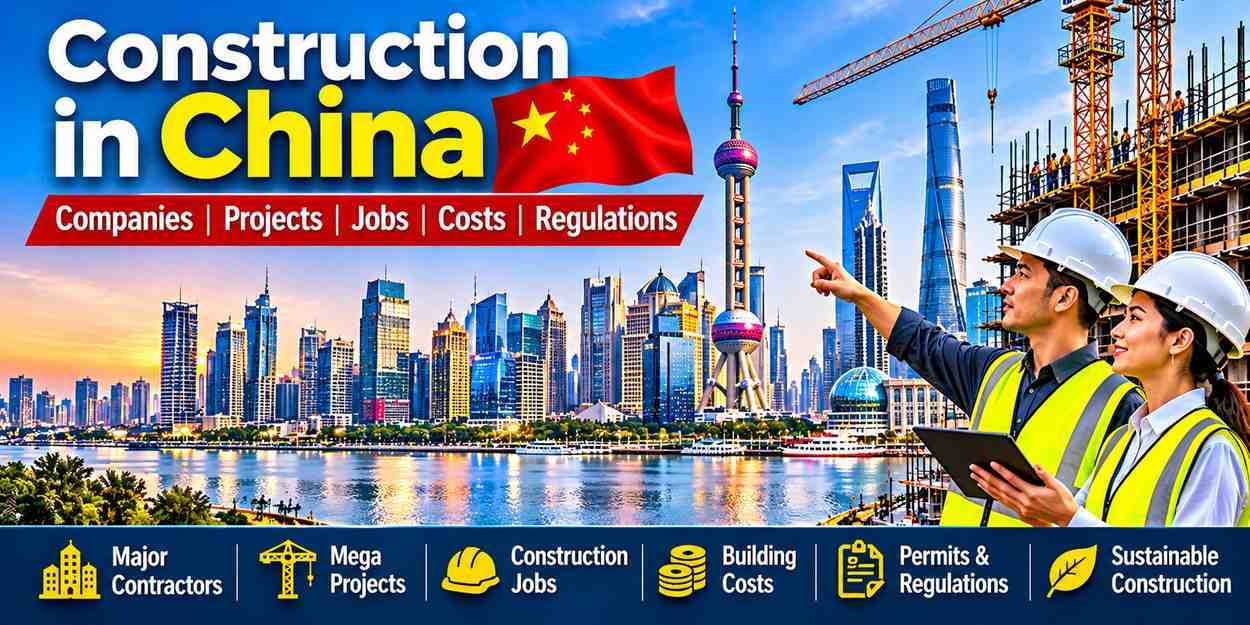
Construction in China
Explore construction in China, including major contractors, infrastructure, high-speed rail, bridges, industrial facilities, building regulations, project costs and engineering careers. This country hub is designed for construction professionals, suppliers, jobseekers and international readers researching the Chinese construction market.
Browse our International Construction Hub for other countries. China-specific company profiles, jobs guides and Q&As will be added as research is completed.
Explore China Construction Topics
- China’s Construction Industry
- Leading Construction Companies and EPC Contractors
- Infrastructure and Major Projects
- Residential, Commercial and Urban Renewal
- Industrial Construction and Energy
- Construction Laws, Permits and Standards
- Construction Costs and Estimating
- Construction Jobs and Engineering Careers
- Construction Across Major Chinese Cities
- Building Technology, BIM and Prefabrication
- Safety, Sustainability and Procurement
China’s Construction Industry
China’s construction sector covers residential and commercial buildings, industrial facilities, highways, high-speed rail, bridges, tunnels, ports, power networks, water infrastructure and urban renewal. The country has large state-owned engineering groups alongside provincial contractors and specialist private businesses. Activity differs substantially by province, city, funding source and project type, so a national headline cannot describe every local market.
Leading Construction Companies and EPC Contractors
Large Chinese construction groups operate across general building, civil engineering, transport, energy and international engineering-procurement-construction (EPC). Some have numerous subsidiaries with different licences and project portfolios. When comparing contractors, verify the precise operating entity, enterprise qualifications, current project references, safety record, financial capacity and local bidding eligibility. Explore our Top 40 Construction Companies in China (2026 Edition) for prominent groups and their specialist capabilities.
Infrastructure and Major Projects
High-speed rail, metro networks, bridges, expressways, ports, airports, water systems and power infrastructure illustrate China’s engineering capabilities. Project status must be checked: a proposal, approved scheme, tender, awarded contract and active construction site are not interchangeable. Major public projects may be subject to formal tendering rules and specific procurement processes.
Residential, Commercial and Urban Renewal
Housing construction, mixed-use districts, public facilities, hospitals, schools, logistics buildings and renovation of existing urban neighbourhoods form different segments of the market. Urban renewal, maintenance and energy-efficiency upgrades deserve separate attention from new-build developments. Project feasibility depends on demand, financing, site conditions and municipal requirements.
Industrial Construction and Energy
Manufacturing plants, data centres, semiconductor facilities, logistics centres, renewable energy, transmission systems and industrial parks involve specialist construction teams. Industrial work can require demanding mechanical, electrical, process, clean-room or environmental specifications. International investors should check applicable approvals, technical standards and contract requirements with local advisers.
Construction Laws, Permits and Standards
China’s construction framework includes the Construction Law, Civil Code, bidding rules, safety and quality regulations, contractor qualification requirements and national technical standards. The Ministry of Housing and Urban-Rural Development (MOHURD) and local authorities have important supervisory roles. Requirements vary with project category and jurisdiction. Qualified local professionals should confirm permits, design review, fire safety, environmental requirements, tendering and completion acceptance for each project.
Construction Costs and Estimating
Construction costs differ by city, building specification, ground conditions, structural system, materials, labour, equipment, logistics, energy systems and contract terms. Estimates are commonly prepared in Chinese yuan (CNY/RMB). A useful budget separates groundworks, structure, envelope, mechanical and electrical services, finishes, professional fees, statutory costs and contingencies. Our construction calculators can help with basic quantities, but local units, standards, material dimensions and prices must be checked before use.
Construction Jobs and Engineering Careers
Careers include civil and structural engineers, project managers, quantity surveyors, BIM specialists, safety professionals, surveyors, equipment operators, electricians, welders and specialist trades. Qualifications, language skills, registration, employer requirements and work authorisation vary by role. Future guides will explain career pathways and recruitment considerations rather than claim to advertise live vacancies.
Construction Across Major Chinese Cities
Beijing: public facilities, transport, renewal and institutional construction. Shanghai: commercial development, infrastructure, logistics and refurbishment. Shenzhen and Guangzhou: dense urban construction, transport and industrial facilities. Chengdu and Chongqing: regional infrastructure, bridges, tunnels and industrial projects. Wuhan: transport, manufacturing and urban development. These are broad sector examples; current project activity should be verified locally.
Building Technology, BIM and Prefabrication
China’s construction industry uses prefabricated components, digital design, BIM, mechanised tunnelling, modular approaches and advanced monitoring on suitable projects. Benefits depend on design coordination, manufacturing quality, transport logistics and site integration. Technology should be evaluated against measurable performance rather than novelty alone.
Safety, Sustainability and Procurement
Contractors and project owners must address workplace safety, subcontractor oversight, payment arrangements, quality assurance, environmental compliance and applicable tender rules. Sustainability priorities may include energy performance, efficient materials, waste reduction, retrofit quality and lower-carbon construction methods. The precise obligations depend on current national and local requirements.
Upcoming China Construction Resources
- Top 40 Construction Companies in China (2026 Edition) — published: company profiles, specialist sectors, comparison table and corroborated website references.
- 20 construction careers and jobs guides: engineering roles, skills, qualifications and employment considerations (planned).
- 20 construction Q&As: practical questions on permits, materials, costs, safety and construction methods (planned).
Frequently Asked Questions About Construction in China
Which are the largest construction companies in China?
Major groups include China State Construction Engineering Corporation, China Railway Group, China Railway Construction Corporation, China Communications Construction Company and Power Construction Corporation of China. A formal size ranking needs consistent, current financial data.
Are construction regulations the same throughout China?
National laws and standards provide a framework, but provinces and municipalities implement additional procedures and requirements. Confirm the applicable local rules.
What does EPC mean in Chinese construction?
Engineering, procurement and construction is a delivery model in which a contractor or consortium undertakes defined design, purchasing and construction responsibilities under the contract.
How much does it cost to build in China?
Costs depend on the city, building type, materials, labour, site conditions, specifications and project scope. Obtain an itemised local estimate in RMB rather than relying on one national average.
Can foreign companies work on construction projects in China?
Potential participation depends on the project, investment structure, contractor qualifications, procurement rules and other applicable requirements. Obtain qualified local legal and technical advice.
Where can I find construction jobs in China?
Check verified employer career pages and reputable recruitment services, and confirm qualifications, language expectations, work authorisation and vacancy dates.
Research and official guidance
For current construction rules, consult the Ministry of Housing and Urban-Rural Development and relevant provincial or municipal authorities. The Chambers Construction Law 2026 guide provides an English-language overview of legislation and procurement. Verify official translations and legal applicability before relying on any summary.
Editorial note: Laws, project status, costs and business structures change. This guide is informational and does not replace Chinese legal, engineering or procurement advice.