



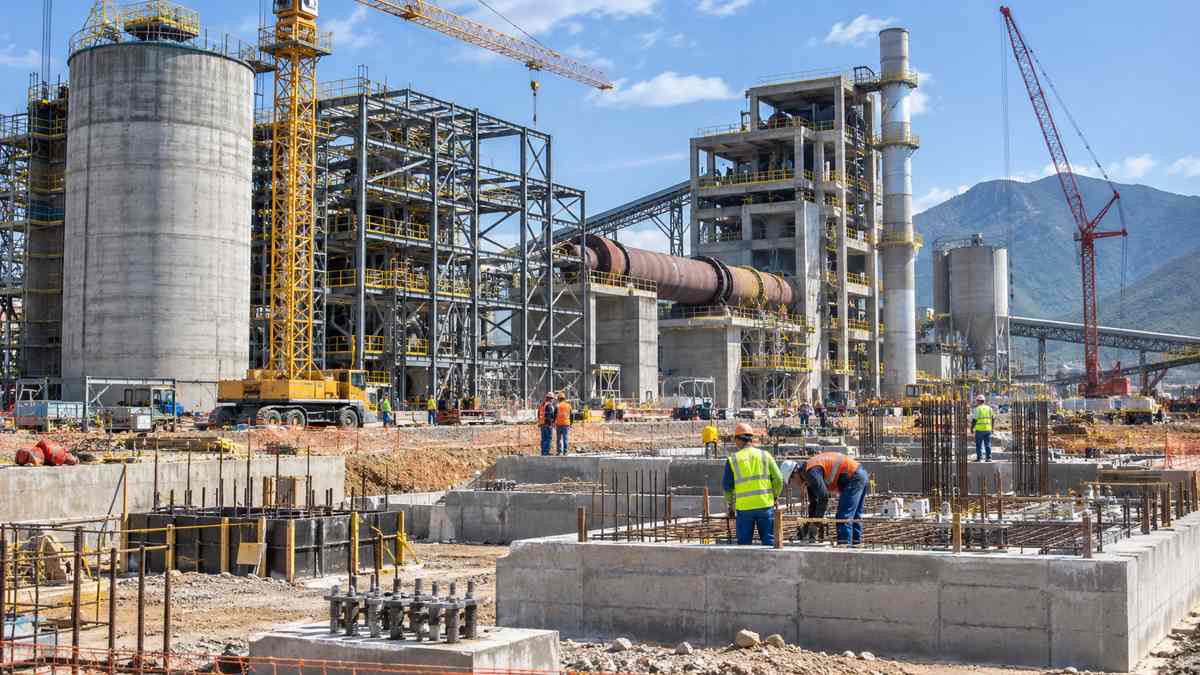
PPC’s R3.1 billion Western Cape cement plant advances
PPC’s RK3 integrated cement plant at Riebeeck West in the Western Cape is progressing against a R3.1 billion approved investment budget. Designed to produce 1.5 million tonnes annually, the facility will modernise existing manufacturing capacity rather than simply add an equivalent amount of net new supply to the market.
The company’s November 2026 interim results reported cumulative project expenditure of R2.212 billion, including prepayments and foreign exchange effects. Construction completion is targeted for January to March 2027. Commissioning and commercial production should be distinguished from the completion of construction.
Progress across major construction packages
PPC reported design and procurement nearing completion, with civil works approximately 85% complete and structural, mechanical and electrical erection around 40% complete. Work on the substation and switching station had reached approximately 90%. These figures demonstrate why the overall progress of an industrial facility cannot be measured by civil works alone.
Sinoma is responsible for engineering, procurement and construction. As equipment installation advances, coordination between steelwork, electrical systems, mechanical equipment and supporting infrastructure becomes increasingly significant.
Building foundations for industrial equipment
Cement manufacturing equipment can impose substantial static and dynamic loads. Foundation design must consider the machinery manufacturer’s requirements, soil conditions and applicable engineering specifications. Anchor bolt positioning and equipment alignment are especially important because late corrections can disrupt installation sequences.
Industrial construction also requires careful management of lifting operations and temporary access. Large components may need dedicated delivery routes and engineered lifting arrangements. These preparations should be planned before equipment arrival rather than improvised around completed structures.
Energy efficiency and manufacturing modernisation
The facility is expected to incorporate dedicated solar generation and more efficient production technology. PPC intends to reduce fuel and electricity consumption and improve environmental performance per tonne produced. Actual operating results will depend on commissioning and subsequent plant performance.
What could RK3 mean for building contractors?
More efficient regional production could improve supply reliability and manufacturing competitiveness. However, it would be premature to promise lower retail cement prices. Distribution costs, demand, product specifications, competition and commercial pricing decisions all influence what contractors pay.
Construction companies should continue to compare delivered material prices, confirm product suitability and manage storage carefully. Cement procurement decisions should reflect the required performance class and project specification, not price alone.
Regional contractors with long-duration projects should also review delivery schedules and supplier contingency plans. During the transition between older and newer production facilities, reliable communication with merchants and concrete suppliers can be more valuable than speculative assumptions about future plant output.
Preparing the plant for operation
As construction progresses, attention shifts towards equipment testing, operating procedures and workforce training. Commissioning must establish that individual systems and the integrated production process function correctly. The project’s longer-term significance will ultimately depend on safe, reliable operation and its ability to serve regional construction demand competitively.
Explore our building resources, contractor directory and construction suppliers.
