



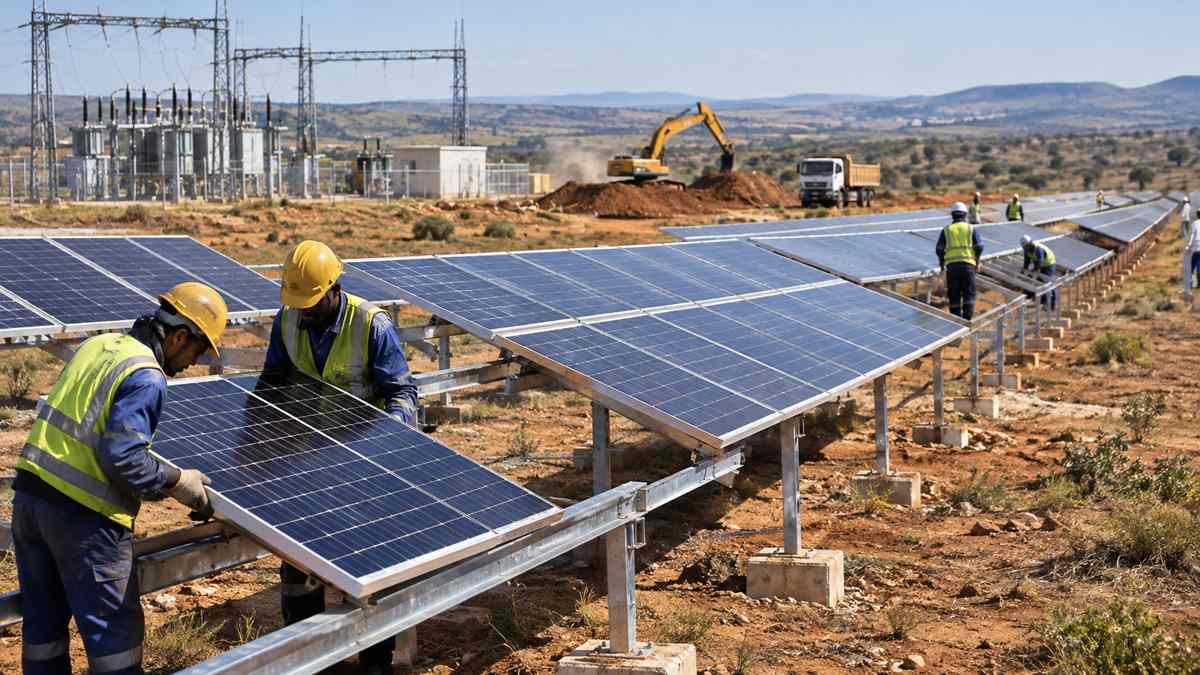
South Africa’s 126 MW Noko solar project enters construction
Scatec announced on 26 November 2026 that Lyra Energy had secured financing for the 126 MW Noko solar project and that construction was commencing. The development, near the boundary between the Free State and North West, is intended to supply commercial and industrial electricity customers under long-term agreements. Operations are targeted for the first half of 2028.
According to Scatec’s announcement, its expected design and construction revenue is approximately US$100 million, with an equity contribution of about US$13 million. Standard Bank is providing project debt. These amounts should not be confused with the overall capital cost of the development.
From financial close to site establishment
Financial close enables the project to proceed with funded construction commitments. On a utility-scale solar development, early site activities typically include surveying, establishing temporary facilities and preparing access for deliveries. Environmental restrictions and approved work boundaries must be translated into practical instructions for each contractor. The precise construction packages for Noko have not been disclosed in the announcement.
Earthworks and solar mounting infrastructure
Solar farms cover extensive areas, making the interaction between topography and drainage particularly important. Civil engineers need to preserve suitable runoff paths while providing stable equipment access. Geotechnical investigations inform foundation selection, and trial installations can help confirm whether the proposed foundation system performs as expected before repetitive installation begins.
Surveyors also play a vital role in maintaining alignment across large arrays. A small positioning error repeated across hundreds of supports can create substantial rework. Contractors should record installation checks and resolve discrepancies before module mounting starts.
Electrical construction and grid interfaces
Electrical work typically includes DC cabling, inverter installation, medium-voltage collection networks and protection systems. Cable trench routes need coordination with roads, drainage and foundations. Testing and energisation must follow approved procedures led by authorised specialists. A completed array is not necessarily a revenue-generating asset until its connection and commissioning requirements are satisfied.
Opportunities for South African construction businesses
Renewable energy projects can generate demand for plant hire, transport, civil works, fencing, surveying and specialist electrical services. However, these are examples of typical industry opportunities rather than confirmed Noko tenders. Businesses should monitor official procurement channels and prepare relevant safety records, experience references and evidence of technical capacity.
Why corporate electricity demand matters
Noko follows Lyra’s earlier solar development and reflects the importance of privately contracted electricity demand in financing renewable infrastructure. For construction businesses, the broader significance is the potential for successive projects to support specialist skills and equipment supply chains. Each development still depends on financing, approvals and connection arrangements, so prospective suppliers should avoid treating an announced pipeline as guaranteed future work.
Explore our building resources, contractor directory and construction suppliers.
