



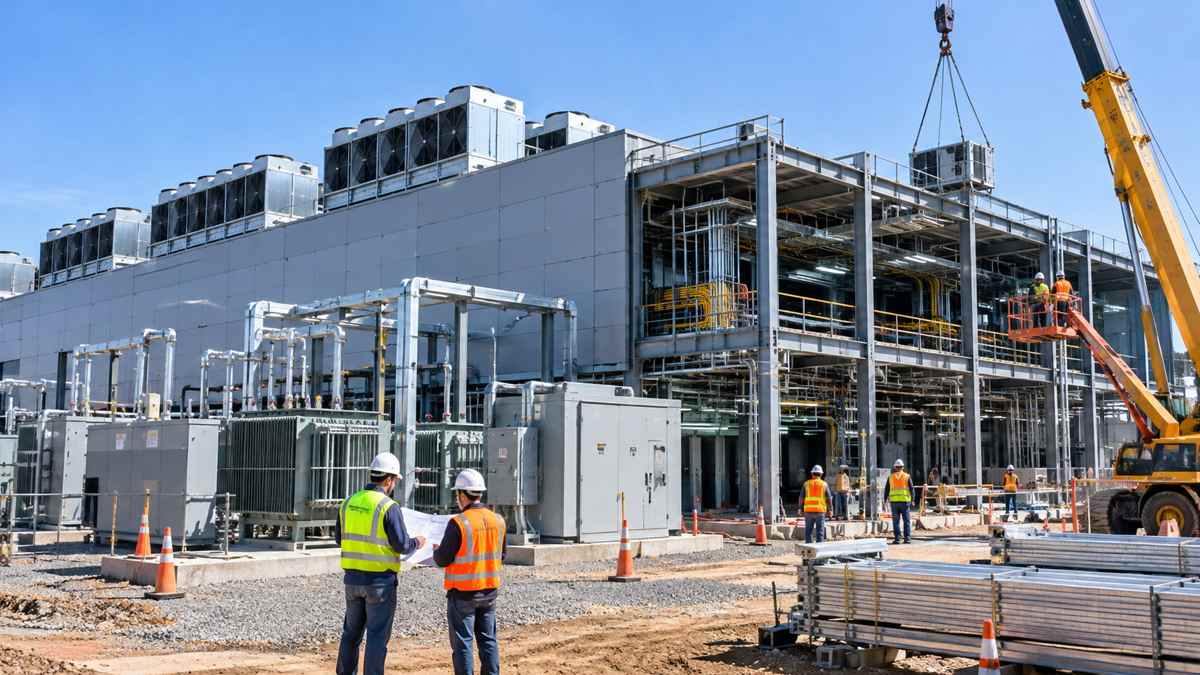
Data center construction in the United States: power, cooling and commissioning
Site selection and utility capacity
Data centers require more than a suitable building plot. Electrical utility capacity, connection schedules, fiber connectivity and local permitting can determine whether a site is viable. Water availability, flood risk and community concerns also influence the choice of cooling systems and site layout.
Building and mechanical systems
Structural grids, floor loading, equipment access and cable routing must be coordinated with mechanical and electrical design. Cooling may use air or liquid-based approaches depending on equipment requirements. Electrical redundancy and backup arrangements are project-specific and should be evaluated against the owner’s operational objectives and applicable codes.
Commissioning and handover
Long-lead equipment procurement should be coordinated with construction milestones. Testing individual systems is only part of commissioning: integrated testing must demonstrate the required response to representative operating conditions and failures. Operations teams need documented procedures, training and maintenance access before accepting the facility.
For energy efficiency resources, consult the US Department of Energy.
Establishing the electrical infrastructure early
Utility connection availability should be investigated before a developer commits to the construction schedule. A building can be structurally complete yet unable to operate if electrical infrastructure is not ready. The design team must coordinate the required equipment space, access routes and delivery windows with the utility and specialist contractors. Local authorities and utilities may impose different requirements depending on the proposed site.
Choosing an appropriate cooling strategy
Server equipment generates heat that must be removed reliably. The choice of cooling technology depends on anticipated equipment density, climate, water availability and operating requirements. Early coordination between mechanical and electrical engineers helps establish equipment loads and the space needed for distribution systems. Future changes in equipment should also be considered where the owner expects capacity to increase.
Managing construction sequencing
Data center projects often involve overlapping civil, structural and building services packages. Large equipment may need to enter the building before some walls or external finishes are completed. Contractors should agree delivery routes and temporary weather protection in advance. Cleanliness requirements become particularly important as sensitive equipment is installed and testing begins.
Measuring energy and water performance
Owners may use power usage effectiveness to compare total facility energy consumption with the energy consumed by IT equipment. Water consumption should be assessed separately where cooling uses water. Design estimates are useful for comparing options, but actual operating measurements are needed to understand how a completed facility performs under changing loads and weather conditions.
Preparing for phased expansion
Some facilities are developed in stages as demand grows. The master plan should consider future equipment access, utility capacity and construction activities near operational areas. Commissioning records, equipment documentation and maintenance procedures help operations teams manage these transitions. Each project requires qualified design professionals and compliance with the locally adopted building, electrical and fire codes.
Explore more construction resources
Visit our United States construction hub, explore international construction or browse Construction South Africa.
