



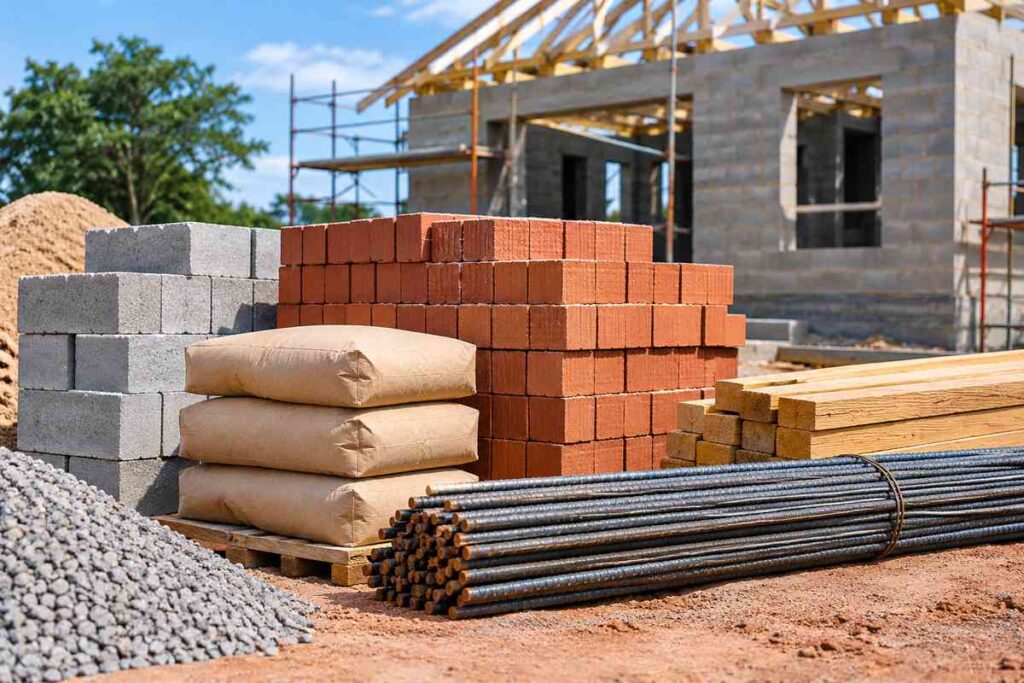
Fibre cement board is a manufactured sheet made from a cementitious matrix reinforced with fibres. Modern products are used for building cladding, ceilings, fascias and other specified applications. They combine a mineral-based material with reinforcement that improves handling and performance, but the correct product and installation system must be selected for each application.
Where is fibre cement board used?
In South Africa, fibre cement products are commonly available as flat sheets, decorative planks, ceiling boards and roof-edge components. Some products are intended for external exposure, while others are designed for sheltered interiors. A board suitable for a ceiling is not necessarily suitable for an exterior facade or a floor. Check the manufacturer’s declared application and supporting structure requirements.
Advantages and limitations
Fibre cement can offer good dimensional stability and resistance to deterioration in suitable conditions. Its mineral composition can also be useful in assemblies with fire performance requirements. However, individual products differ in thickness, density, strength and fire classification. Sheets may crack if mishandled or installed on an uneven frame. They can be heavier than some alternative lining materials and require appropriate handling.
Is fibre cement waterproof?
Some fibre cement boards tolerate moisture exposure, but the board alone does not make a wall or shower waterproof. Joints, penetrations, flashings and membranes must be detailed as part of the complete assembly. Exterior cladding may require a drainage cavity and weather-resistant backing. In a bathroom, use a board approved for the intended wet-area system and follow the waterproofing manufacturer’s instructions.
Practical installation considerations
For a facade renovation, first check that the supporting frame is straight, sound and suitable for the selected board. Follow the specified support spacing, fastener type, edge distances and joint details. Use compatible coatings and sealants where required. Cutting cement-based products can release hazardous respirable dust, including crystalline silica; use manufacturer-approved cutting methods, dust controls and appropriate protective equipment.
Older fibre cement sheets and asbestos
Older cement roofing or cladding may contain asbestos. Appearance alone cannot reliably establish whether a sheet contains asbestos. Do not drill, cut, sand or break unidentified older material. Arrange assessment by a competent asbestos professional and follow applicable South African asbestos regulations before removal or disturbance.
For modern product installation guidance, consult Everite’s Nutec technical brochures. Find relevant building material suppliers and exterior construction services.
Frequently asked questions
Many products accept suitable coatings. Follow the manufacturer’s surface preparation and paint recommendations for the particular board and exposure.
No. Fibre cement has a cementitious matrix, whereas gypsum board has a gypsum core. Their intended uses, fixing methods and moisture performance differ.
Modern products are generally manufactured without asbestos. Confirm the product declaration; do not assume older unidentified sheets are asbestos-free.
Related construction questions
- What is the difference between plywood and MDF?
- What is expanded polystyrene insulation?
- What is galvanised steel?
Have More Construction Questions?
Explore our South African construction knowledge hub for practical answers about building materials, costs, regulations, construction methods and more.
Browse All Construction Questions